Posts

Showing posts with the label carbon offsetting

Scottish officials raised concerns that Shell's £5m tree-planting scheme would be seen as "greenwashing"

Image
As a result of UK Freedom of Information requests, internal emails seen by The Ferret investigative blog have revealed that, in the run-up to an announcement by Shell last October that it was funding a new £5m tree-planting initiative, Forestry and Land Scotland (FLS) officials raised a number of concerns. In August 2019, Jo Ellis, FLS head of planning and environment, noted “I do think we need to be cautious about how we communicate this...I don’t want us to come across as falling for the greenwashing. The fact remains that mitigation work such as tree planting will not be sufficient to offset carbon emissions for the long term (we need to be reducing the use of fossil fuels).” “The tiny amount Shell is putting into green initiatives is dwarfed by what it is still spending on investigating new oil and gas reserves, and in blocking initiatives to set legally binding emissions reductions targets.” she added. “What we should actually be doing is reducing emissions – e.g. stop using petro...

Pulling carbon dioxide from the air by farming

Image
Exciting news as 'rock weathering' experiment pulls carbon dioxide from the air and boosts crop production by 12%. The Working Lands Innovation Center (WLIC) has been partnering with farmers, ranchers, government, the mining industry and Native American tribes in California on some 50 acres of cropland soil amendment trials and their experiments have yielded results that may be another important step in fighting climate change. ROCK CHEMISTRY Many processes weather rocks on Earth’s surface, influenced by chemistry, biology, climate, and plate tectonics. The dominant form of chemical weathering occurs when carbon dioxide combines with water in the soil and the ocean to make carbonic acid. About 95% of Earth’s crust and mantle – the thick layer between the planet’s crust and its core – is made of silicate minerals, which are compounds of silicon and oxygen.  When carbonic acid comes in contact with certain silicate minerals, it triggers a chemical process known as the 'Urey...

Beautiful pink snow in the Italian Alps heralds another environmental catastrophe

Image
An alarming, yet beautiful new phenomena, has gripped both Alpine tourists and scientists alike - the appearance of pink snow on the Presena glacier in Italy.  Known as the “giant of the alps”, Presena sits 3,069 metres above sea level and is described as a paradise for all those who love nature, history and mountain sports. Situated on the border between Val di Sole and Valle Camonica, between Trentino and Lombardy, the glacier is part of the Presanella mountain group. A type of algae usually found in Greenland has started to grow there - and it’s turning the glacier pink. The plant, known as Ancylonema nordenskioeldii, is present in Greenland's so-called Dark Zone, where the ice is also melting. Despite its rosy appearance, pink snow is not good news on the climate change front. Usually, ice reflects over 80 per cent of the sun’s radiation back into the atmosphere. As the ice changes colour, it loses the ability to reflect heat, meaning the glaciers are starting to melt fast...

UK's National Grid goes coal-free for the longest period since the Industrial Revolution

Image
Coal has not been used to generate power for 60 days Partly due to a collapse in demand during the Coranavirus lockdown and a greater emphasis on using solar power, the UK National Grid managed to take coal plants off the network on April 10th and to avoid bringing them back online in Britain since. Britain continues to phase it out, with two of Britain’s oldest coal-fired power stations having closed at the end of March this year, leaving just three left on the mainland. This is a major shift from 10 years ago when 40% of the nation's energy came from coal and only 3% came from renewables such as wind and solar power. In 2020, the UK has the biggest offshore wind industry in the world, with the 659MW Walney Extension the world’s biggest operational offshore wind farm to date. Located in the Irish Sea near Cumbria and covering an area equal to 20,000 football pitches, it is designed to operate for 25 years and supplies enough electricity to power 590,000 UK homes. Over...

Seeing the wood for the trees in carbon offsetting

Image
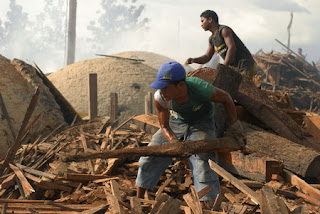
Operation Arch of Fire combatting illegal logging in Brazil Companies are falling over themselves to offer their customers ways of contributing to cutting carbon emissions with good intent, offering them easy, “tick-box” options at the end of their on-line purchases to participate. But are these schemes any good ? How can the consumer be assured of the benefits of the scheme they have implicitly signed up to ?  A major part of the problem is that the majority of carbon offsetting projects require a long-term investment which needs to be protected for its lifetime if it is to deliver all the benefits promised when first initiated.  Worldwide tree-planting schemes are an excellent example of how good intentions can go astray.  An endangered Mogno tree in Brazil will have to stand for 25 years, in good health, to sequester 275 Kg of carbon dioxide. It must be protected against illegal logging, disease and land clearing, often in remote sites where the...